
A rail siding on a site plan looks like a fixed asset. Under Slovak law it is a railway in its own right, and it carries wagons only while three things hold: an operating permit from the Transport Authority, a contract with the state network manager ŽSR at the junction, and a turnout that someone maintains. The number of permits is falling. The authority counted 358 valid siding permits at the end of 2024 and 349 a year later. This post explains the three pieces, what they cost and what it takes to wake a dormant siding, before a tenant or an investor pays extra for rail.
What a rail siding is under Slovak law
Act 513/2009 on railways, in the text in force since 1 April 2025, counts sidings among railways in section 2(3), next to the lines themselves. Section 2(5) defines a siding as a railway connected to a line, directly or through another siding, and used to move rail vehicles for loading, transhipment and unloading in plants, warehouses, ports and terminals.
That status brings duties an access road does not have. Under section 28(1) and (2) the owner must keep the siding permanently in operation and in working order. An owner who cannot must offer it for sale under section 28(3). If nobody buys or rents it, section 28(13) makes the owner propose its closure and remove the track afterwards. The safety valve is section 30(3) and (4): an operator may restrict operation while no traffic runs, as long as the track and its equipment endanger nobody.
Part of the heavy rail regime stops at the fence. Sections 62(3)(c) and 91a(c) exempt private infrastructure used for its owners’ freight, sidings included, from the rules on interoperability and from the safety certificate regime. Annex 12a leaves private sidings out of the list of what counts as railway infrastructure. Building work on the track still needs the Ministry of Transport, which section 102(1)(aa) makes the special building authority.
The operating permit: personal, time-limited and counted
Only the holder of an operating permit from the Transport Authority, Dopravný úrad, may run a siding. Section 29(1) adds a contract with the owner where the operator does not own the track, qualified staff and written internal rules. Section 29(3) asks for a degree in transport, construction, mechanical or electrical engineering plus three years in a managing role in railway operation, or a secondary education plus five years. If no board member has that, the company must employ a responsible representative full time for the whole life of the permit. The fee is EUR 200.
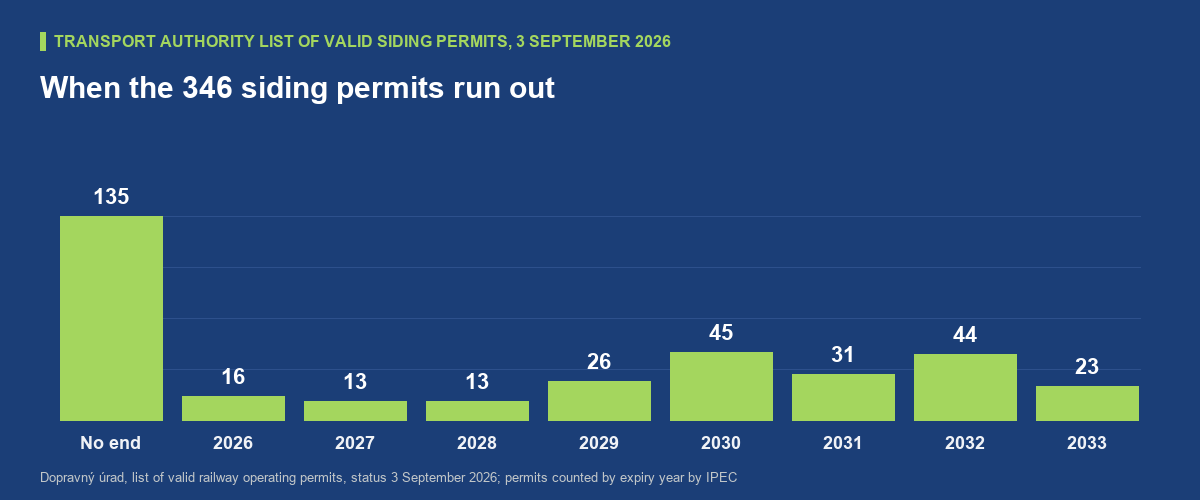
Section 29(6) fixes the term at whatever the permit states, at least five years, and adds the sentence that matters in a deal: the permit does not pass to a legal successor. It lapses when it expires or is revoked, when the operator ceases to exist, or when the railway is closed. A share deal leaves it with the company. A buyer of the land alone needs its own permit or an operating contract with a holder.
The authority’s figures show the drift. In 2025 it issued 10 railway operating permits and cancelled 14, according to its annual report for 2025. Its list of 3 September 2026 shows 346 siding permits, 16 of them ending in 2026 and 135 with no end date at all. Those fit only the earlier rules: the Act has required a stated term since 2010, and section 112(3) keeps older permits alive until they expire or are revoked.
The contract with ŽSR at the junction
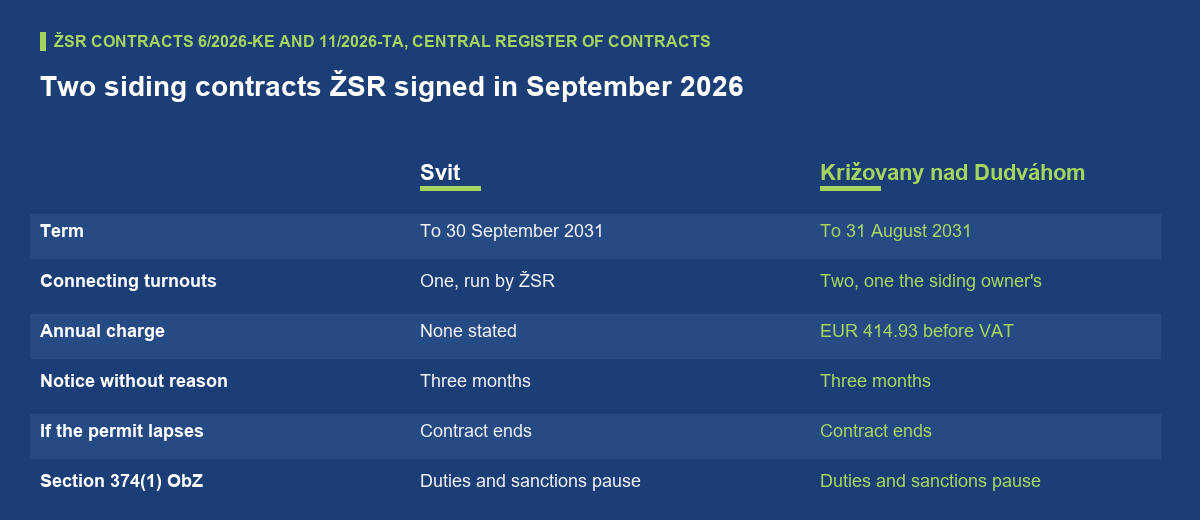
Where a siding meets a line, section 13(2) requires the boundary to be defined and visibly marked, and the two operators to agree the technical solution and their rights and duties in a contract. ŽSR publishes these contracts in the central register. Two signed in September 2026 show what they contain. In the contract for a siding at Svit, the boundary sits at kilometre 206.363, the connecting turnout is in ŽSR’s care, ŽSR maintains it at its own cost, and the price article is left empty. At Križovany nad Dudváhom one of two turnouts belongs to the siding owner, and ŽSR cleans it, clears it and inspects it four times a year for EUR 414.93 a year before VAT.
Both contracts run five years. Either side may end them on three months’ notice without a reason, and both end automatically when the operator’s permit lapses, unless a new one applies from the next day. Both suspend duties and sanctions for late performance while circumstances excluding liability under section 374(1) of the Commercial Code last. Our glossary entry tests which obstacles actually excuse a party.
The turnout is where the law puts the cost. Under section 8(3) whoever builds a new siding builds the turnout and runs and maintains it permanently. If an owner neglects it, ŽSR may repair it at the owner’s expense under section 28(4), and section 109(2) allows a fine of EUR 800 to EUR 10,000. An owner who permanently stops running or maintaining the turnout must hand it to ŽSR free of charge under section 28(5).
Reviving a dormant rail siding
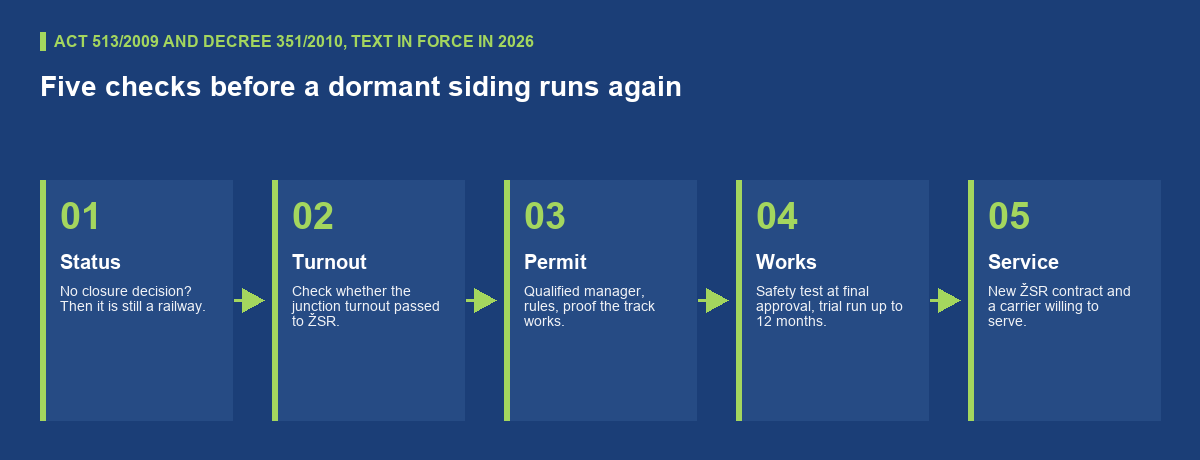
A siding that has seen no wagon for years is not necessarily dead in law. The first question is whether it was ever closed. Closure needs a decision of the Ministry of Transport on the owner’s proposal under section 102(1)(af), with the consent of the owners of any railway connected to it under section 12(2). Without that decision the track is still a railway, with an owner’s duties attached, and it can be run again.
The second question is the permit. Under section 102 of Decree 351/2010 the applicant proves qualification, title or an operating contract, and that the track is operable, by a mere declaration only where unavoidable. It also describes the siding: start and end, track lengths, turnouts, gauge, steepest gradient, tightest curve, axle load and road crossings, with a current site plan. On a siding limited to 40 km/h the operator writes its own rules and moves wagons as shunting.
If the track must be rebuilt, the Building Act applies, the technical safety test becomes part of the final approval, and trial operation may last up to 12 months. Our post on why a finished hall can still wait walks through the same final approval for buildings. Public money points elsewhere: the EUR 300 million scheme the European Commission approved for Slovakia in July 2025 covers up to half the cost of new freight wagons, not track. We have not found a Slovak programme that pays for the siding itself.
What to ask before you pay for rail access
For an occupier or an investor the useful questions are short. Who holds the operating permit, and until when? The authority’s list answers that in a minute. Is the holder the landlord, a park operator or a former tenant, and will the permit survive the transaction, given that it does not pass to a legal successor? What does the ŽSR contract say about its term, the turnouts and the annual charge? When did the last wagon arrive, and which carrier would serve the siding, how often?
Then write the answers into the lease. A lease that promises rail access should name who operates the siding, who pays for the track and the turnout, and what happens to rent and term if the permit lapses or ŽSR ends its contract on three months’ notice. A siding is only as useful as the rail network behind it, and our post on the terminals and corridors beyond the gate covers that half of the question.
Conclusion
A rail siding in Slovakia is three legal objects that share one piece of track. The permit is personal and time-limited, and the number of valid ones fell from 358 to 349 in a single year. The ŽSR contract runs five years and can end on three months’ notice. The turnout carries the cost, and an owner who stops maintaining it hands it to ŽSR. None of this shows on a site plan or in a brochure. Ask for the permit, the contract and the turnout before rail access goes into the rent, and put the answers into the lease.