
Two customers keep goods in the same Slovak hall. One signs for a marked out block of floor and holds the only key to it. The other hands over pallets and lets the operator decide where they sit. Those two invoices can be taxed in different countries. Warehousing services vs property letting is not a drafting preference but the question that fixes the place of supply, and the place of supply is settled before anybody argues about a rate. The Court of Justice set the test in 2013 and the Slovak tax administration wrote it into its own guidance in 2017.
Why the place of supply is decided before the rate
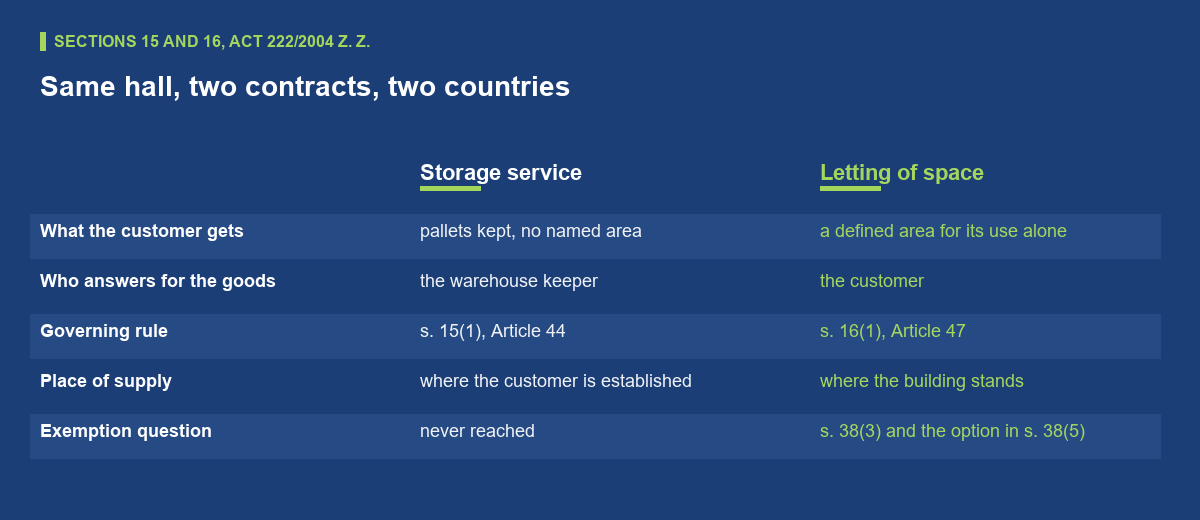
Slovak law asks two questions in order, and most commercial discussions start with the second one. The first question is where a supply is taxed at all. Under section 15(1) of Act 222/2004 Z. z., a service supplied to a taxable person acting as such is taxed where that person has its seat, place of business or fixed establishment. That is the 2026 consolidated wording. Section 15(3) then adds the qualifier that decides this whole article. The general rule applies only where section 16 does not provide otherwise. Section 16(1) provides otherwise for services relating to immovable property. The list runs from estate agency and expert work through accommodation and the granting of a right to use property to the coordination of construction work. For those, the place of supply is where the property is located.
The two provisions mirror Articles 44 and 47 of Directive 2006/112/EC, so the analysis is the same across the internal market. Only once the supply has landed in Slovakia does the familiar exemption question arise. Is the letting exempt, and has the landlord opted to tax it? That is the subject we worked through in VAT on industrial leases in Slovakia. A storage arrangement that never gets into section 16(1) never reaches that question at all. There is no Slovak supply to exempt.
What the Court decided in RR Donnelley
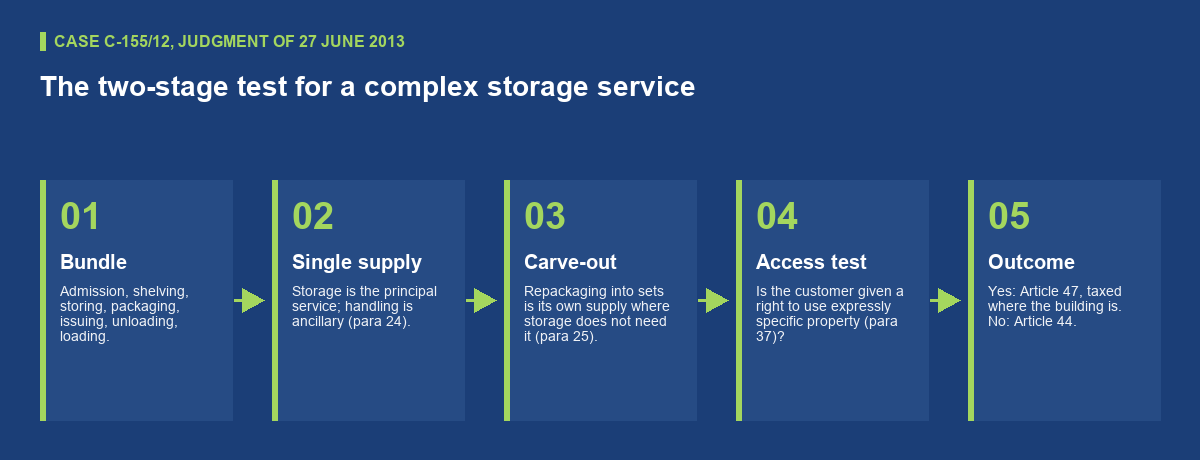
The leading authority is a Polish reference. Case C-155/12 Minister Finansow v RR Donnelley Global Turnkey Solutions Poland was decided on 27 June 2013. The Court of Justice looked at a bundle any logistics manager will recognise: admission of goods to a warehouse, placing them on the appropriate storage shelves, storing them, packaging them, issuing them, unloading and loading them.
The Court worked in two stages. First it asked what the transaction is. At paragraph 24 it treated storage as the principal supply, with reception, placement, issuing, unloading and loading as ancillary services that are not an end in themselves. Paragraph 25 carved out one activity: repackaging goods into individual sets, supplied only to some customers, is an independent principal supply wherever it is not necessary for better storage of the goods.
Then it asked where that single transaction is taxed. Paragraph 34 requires the supply to be connected to expressly specific immovable property. Paragraph 35 requires that property to be a central and essential element of the service rather than a mere setting. The operative part draws both threads together on two conditions. Storage must be the principal service of a single transaction. And the recipient must be given a right to use all or part of expressly specific immovable property. Paragraph 38 states the negative case. Where the customer has no right of access to the part of the building holding its goods, Article 47 does not apply.
The rule the Regulation wrote down
What the Court reasoned from first principles, the EU legislature later codified. Council Implementing Regulation (EU) No 282/2011, as amended by Council Implementing Regulation (EU) No 1042/2013 of 7 October 2013, gained a dedicated subsection on services connected with immovable property. Article 3 of the amending regulation set the start date: Articles 13b, 31a and 31b apply from 1 January 2017. They bind every member state directly, without transposition.
Article 31a(1) restates the threshold, namely a sufficiently direct connection with the property. The two provisions that matter for a warehouse then sit on opposite sides of one word. Article 31a(2)(h) brings the leasing or letting of immovable property within the rule. It expressly includes the storage of goods for which a specific part of the property is assigned for the exclusive use of the customer. Article 31a(3)(b) puts the opposite case outside the rule. Storage in a property is not covered where no specific part of it is assigned for the exclusive use of the customer. The word carrying the freight is exclusive. It is a factual test about the contract, not a label the parties can choose.
Article 13b supplies the raw material for the argument. Immovable property covers any building fixed to the ground that cannot be easily dismantled or moved. It also covers any item permanently installed in that building which cannot be moved without altering it. Landlord racking bolted into the slab can therefore change the character of what is being supplied.
How the Slovak administration reads the same line
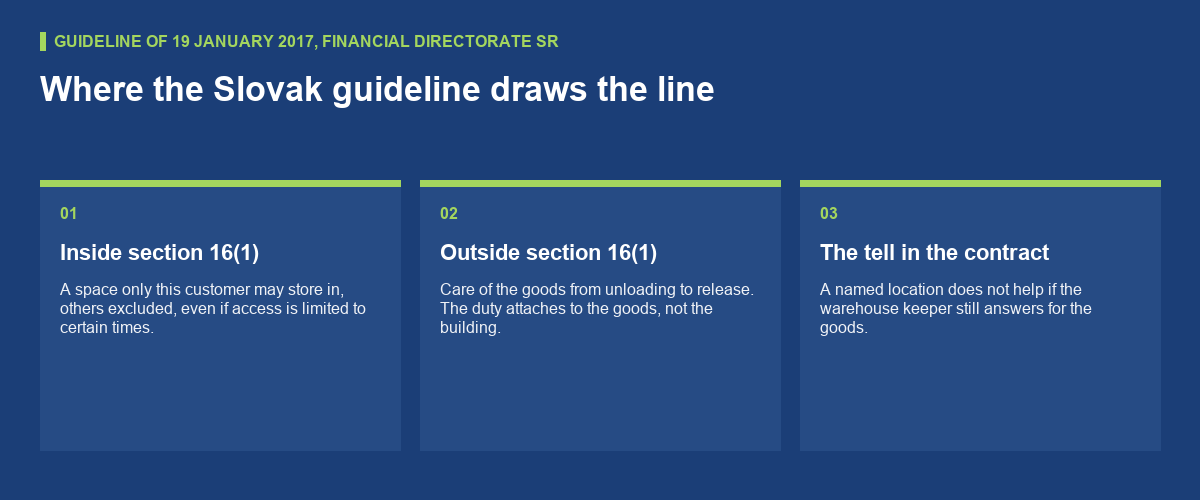
Slovakia did not leave this to inference. The Financial Directorate issued a methodological guideline on services connected with immovable property on 19 January 2017, timed to the entry into application of Article 31a, and it reproduces the RR Donnelley passage directly. Its reading is generous where the space is genuinely allocated. The customer needs an exclusively earmarked area for its goods, meaning an area in which only it may store and others are excluded. Where that holds, the supply can be a service connected with immovable property. It stays one even where the customer may enter only at certain times or on certain conditions.
The guideline is equally direct about the other side. Its section on services that do not relate to immovable property describes the substance of a storage service. It is the taking over of responsibility for the care of the goods, from receipt into the warehouse and unloading, through handling, to release to the owner. Those activities attach to the stored goods, not to the building. One sentence there is worth reading twice. Even where the storage contract names an exact storage location, the service is assessed under section 15(1) if the contract makes clear that the warehouse keeper answers for the goods. The mirror image is a contract handing a defined part of the property to the customer for exclusive use, with the customer carrying the responsibility for it. That is a letting. Example 11 of the guideline runs the same test over aircraft hangarage and splits it exactly along that seam.
Reading warehousing services vs property letting off your own contract
The consequences are administrative before they are financial. Where the supply is a property supply under section 16(1), it is taxed in Slovakia. Section 69(2)(a) then moves the liability to the customer, but only to a customer that has a seat, place of business, fixed establishment or residence in Slovakia. A foreign customer cannot self-account under that provision. The foreign provider itself then becomes a Slovak taxable person under section 5(1). From that moment it has five working days to apply to the Bratislava tax office under section 5(3). Section 5(2)(b) spares a foreign supplier registration only where the recipient is the person liable, and that is exactly what fails in the cross-border storage case.
Only after that does the rate question open. Section 38(3) exempts the letting of immovable property. Section 38(5) lets a payer decide that a letting to a taxable person will not be exempt. Section 27(1) then puts the standard rate of 23 % on the rent. Section 38(6) extends the same regime to subleases, which is how this reaches an occupier who sublets surplus space rather than running the 3PL route. Where the arrangement stays a service under section 15(1), no Slovak tax appears at all and the customer accounts for it at home. Three questions settle it in practice. Does a drawing identify the space. May anyone else store goods there. And who carries the risk in the goods while they sit. All three are settled in the paperwork rather than on the invoice, which is why the wording of the lease agreement decides the tax treatment, and why a hall taken on a triple net lease basis, with the tenant carrying the building, points the opposite way from a storage contract.
Conclusion
The invoice follows the contract, and the contract answers one question before all the others. Warehousing that leaves the operator free to move pallets, and answerable for them, is a service taxed where the customer sits. A defined area handed over for the customer alone is a property supply taxed where the building stands, with a registration duty behind it when neither party is established in Slovakia. Article 31a settled the wording, RR Donnelley settled the test, and the Slovak guideline settled how the administration will read your paperwork. The words in the agreement decide which of the two you signed.