
Slovak industrial investment enters the second half of 2026 with a puzzle on the tape. The first quarter printed one of the thinnest readings in years – yet brokers call industrial the market’s most liquid asset class and expect the year’s big trades to close in the months ahead. Both statements are true, and the space between them is where pricing, buyer behaviour and sale decisions are being made right now. This article reads the numbers behind the market: what 2025 actually delivered, who is buying in 2026, what kind of asset changes hands, and what the yield ladder says to occupiers and owners.
A thin quarter for Slovak industrial investment – after a near-record year
Start with the two numbers that frame the year. In the first quarter of 2026, Cushman & Wakefield counted EUR 89 million of transactions across five deals – a quiet opening by any recent standard. Yet the year it follows was anything but quiet: 2025 closed at EUR 967 million, the second-highest annual volume on record, and industrial led the market with a 46 per cent share – roughly EUR 446 million of sheds, plants and portfolios. The contradiction is smaller than it looks. Slovakia is a small, lumpy market: a handful of large trades decides any quarter, and the broker outlook for 2026 expects sizeable single-asset and portfolio transactions to complete later in the year, with industrial property remaining, in Cushman & Wakefield’s words, the most liquid asset class. Small markets breathe in deal-sized gulps, and annual rather than quarterly volume is the honest unit of measurement. A thin quarter is noise. The buyer pool, the yield ladder and the type of asset that trades are the signal – and each is worth reading separately.
Who buys: capital has come home
The most striking line in the Q1 2026 report is not the volume – it is the origin of the money: all transactional capital in the quarter was of Slovak origin. That is an extreme reading of a real trend. Across 2025, Czech investors led the Slovak market with roughly 30 per cent of volume, Slovak and wider European capital took about a quarter each, and US and Asian money made up the rest. Region-wide the pattern is the same: CEE investment reached EUR 11.8 billion in 2025, up 34 per cent, with CEE-based investors at a record 65 per cent of volume. The names behind the Slovak numbers are increasingly domestic retail funds: Erste Realitna Renta bought the Amazon hall in Sered (62,300 square metres), ZFP Investments took Bory Mall, 365 Invest bought Green Point Offices, Supernova Invest the MAX portfolio, Wia Slovakia a former Ecco warehouse. One nuance matters for owners of industrial stock, though: in 2025 industrial was the one Slovak sector driven by capital from outside CEE – the asset class international money still crosses borders to buy. Sell a good shed and you are marketing to two pools at once – and the domestic one now reads the fine print of a lease as fluently as any London fund.
What trades: leases, not buildings
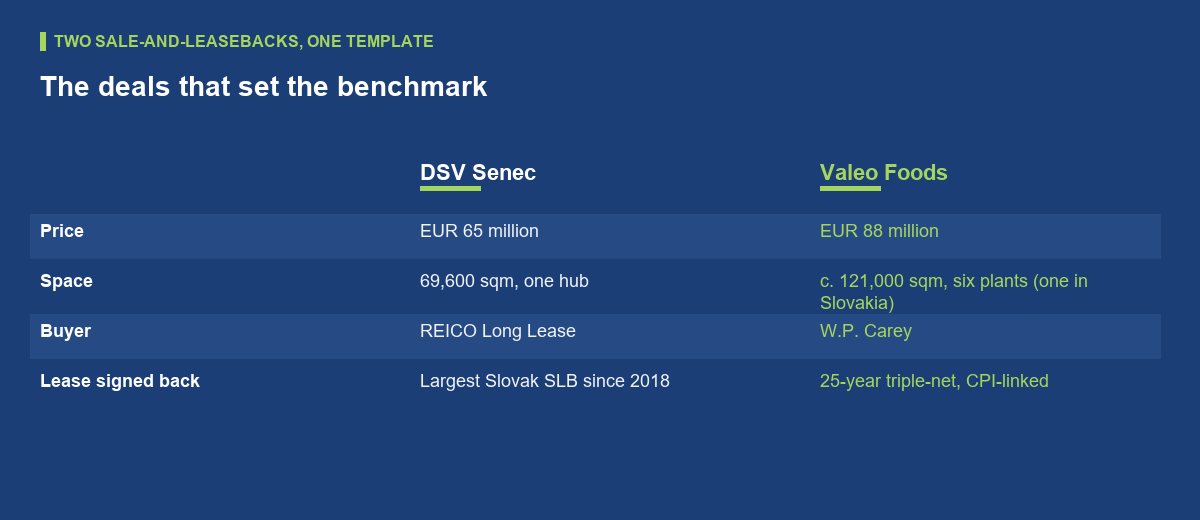
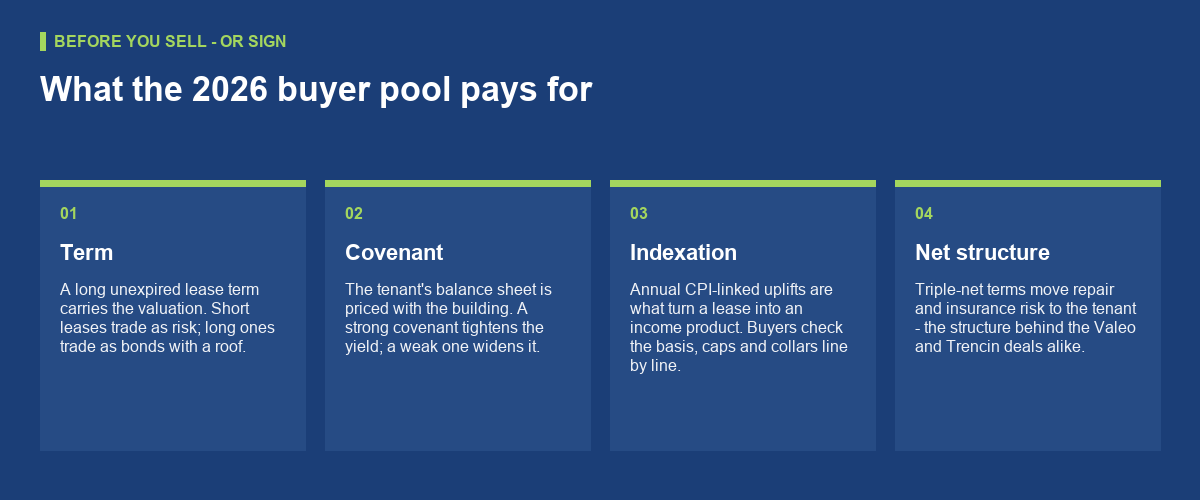
Look at what actually changed hands and a pattern emerges: buyers are not purchasing steel and concrete, they are purchasing income. The largest industrial trade of the last twelve months was a portfolio – P3 took the Stoneweg industrial portfolio of 99,300 square metres across several cities. The benchmark single-asset deal was a lease in disguise: REICO Long Lease paid EUR 65 million for DSV’s 69,600 square metre hub in Senec, the largest sale-and-leaseback in Slovakia since 2018, as our sale-and-leaseback review set out. W.P. Carey’s EUR 88 million deal with Valeo Foods – six food plants across the UK, Czechia and Slovakia, circa 121,000 square metres – was signed on 25-year master leases with annual CPI-linked increases. Even the small trades follow the template: Arete sold its circa 5,600 square metre Trencin park, fully let to Linde Material Handling on a triple-net frame, to Erste Realitna Renta in April 2026. In every case the product is the same: a long weighted average unexpired lease term, a strong covenant, and rent that indexes. The building is the wrapper.
The yield ladder – and the arithmetic beneath it
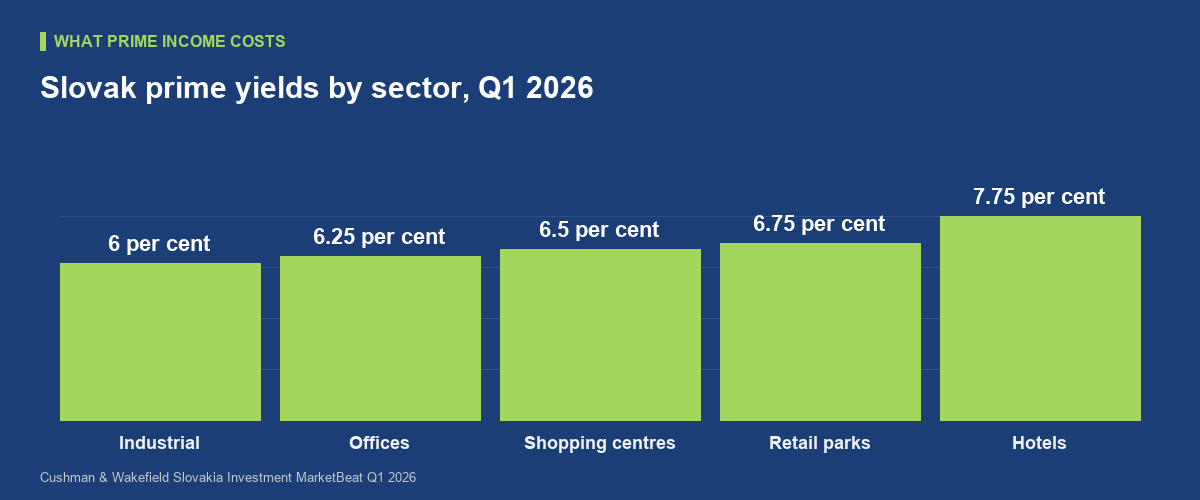
Pricing has held remarkably still through all of this. Prime Slovak industrial assets – the strongest space in the strongest locations, let long – are quoted at a 6.00 per cent prime yield, firm on the quarter and the top of the national ladder: offices at 6.25, shopping centres at 6.50, retail parks at 6.75, hotels at 7.75 per cent. The spread maths – our own arithmetic on the report’s figures – explains the appetite: against a 10-year Slovak government bond at 3.4 per cent, prime sheds offer roughly 260 basis points of excess income; against the 5-year euro swap at 2.4 per cent, roughly 360. That cushion survived a monetary turn: the ECB raised all three key rates by a quarter point effective 17 June 2026 – its first hike since 2023 – and held them steady on 23 July. The regional comparison sharpens the picture: Czech prime industrial has compressed to 4.75 per cent, the European prime logistics average sits at 5.23 per cent, and Poland trades at a level similar to Slovakia’s. For income buyers, Slovakia is the yield pickup within the region; for owners, that same gap is the discount at which their asset sells.
What it means for occupiers and owners
For tenants, the shift in ownership is not abstract. Your next landlord is increasingly a domestic fund answerable to retail savers – a buyer that, at current prime yield arithmetic, pays roughly 17 euros of capital value for each euro of provable annual rent (the yield entry’s rule of thumb). Expect covenant checks, indexation discipline and professional asset management, because your lease is the product being financed. For owner-occupiers, the window the DSV and Valeo deals opened is real but priced in decades: capital released today is exchanged for 25 years of CPI-linked, triple-net obligations – the terms of the leaseback, not the sale price, decide whether the trade was cheap. And the occupational backdrop still favours the tenant side of any negotiation: the Industrial Research Forum panel puts Q1 gross take-up at 128,800 square metres, up 110 per cent year on year, vacancy at 7.72 per cent heading towards about 8, prime rent softened to EUR 5.30 per square metre per month, and renegotiations at 54 per cent of demand. Investors are buying income streams in a market where occupiers currently have room to negotiate the very leases that back them – both sides should notice the asymmetry.
Conclusion
The Slovak investment story of 2026 is not the quiet quarter – it is the structure underneath it. A near-record 2025, a buyer pool that has gone local while industrial still imports capital, pricing that held through the first rate hike in three years, and a deal template that values the lease over the building. For owners, that template is a checklist: term, covenant, indexation, net structure. For occupiers, it is negotiating power – the market is paying for exactly what you sign. Whichever side of the lease you sit on, it pays to know what the other side’s spreadsheet rewards.