
A sale-leaseback answers a question more Slovak manufacturers are asking in 2026: how do you get capital out of a factory without moving out of it? The mechanics are simple – sell the property to an investor and sign a long lease back on the same day – but the economics have shifted from theoretical to topical. The country’s largest such deal since 2018 closed in Senec, long-income buyers are hunting exactly this product across CEE, and bank debt is not getting cheaper. This article assembles what the evidence supports: the deals that actually closed, the yields that price them, and the lease terms that decide whether the capital raised was cheap or expensive.
What a sale-leaseback is – and why manufacturers reach for it now
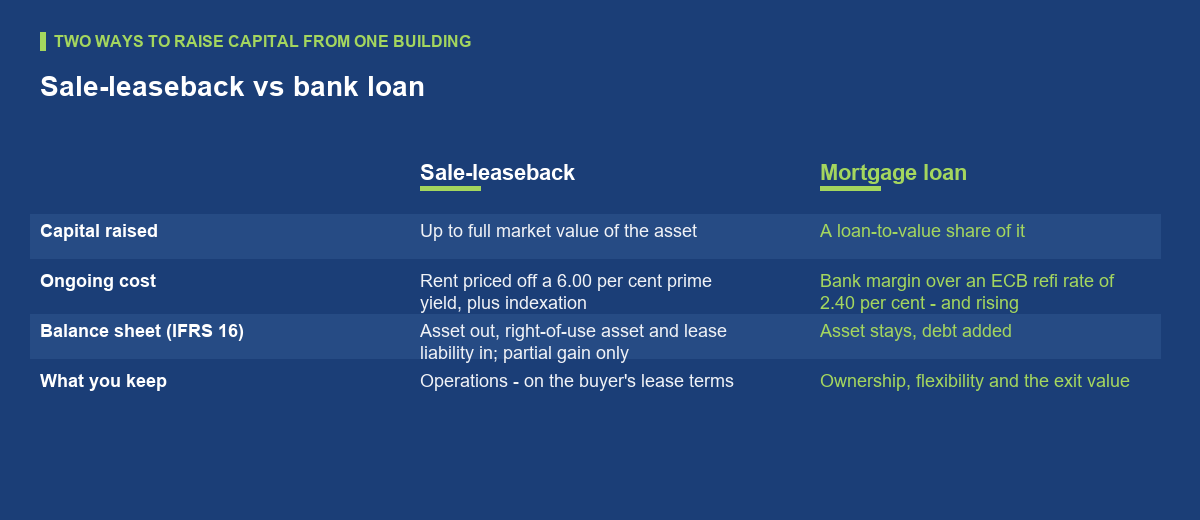
The structure has two legs signed together: a sale of the property at market value, and a lease back to the seller – typically long, typically triple net, so the occupier keeps paying for repairs, insurance and property costs much as an owner would. The seller trades ownership for liquidity while operations continue uninterrupted on the same floor. Why now: the financing alternative is not improving. The European Central Bank raised its key rates by 25 basis points with effect from 17 June 2026 – deposit facility at 2.25 per cent, main refinancing at 2.40 per cent (ECB key interest rates) – so the era of ever-cheaper bank debt is over, and a leaseback prices against property yields rather than bank margins. One honest caveat belongs up front: under IFRS 16 the transaction does not simply move the asset off the balance sheet. The seller books a right-of-use asset for the lease it retains, recognises a gain only on the rights actually transferred, and a deal that fails the sale test is accounted for as a financing (KPMG on IFRS 16 seller-lessee accounting). The case for the structure is cash and flexibility, not accounting cosmetics.
The Slovak deals that prove the market
This is no longer a theoretical CEE product. In February 2025 REICO’s long-income fund bought the DSV logistics hub in Senec – around 69,600 square metres – for EUR 65 million, a transaction reported as the largest sale-and-leaseback in Slovakia since 2018 (Property Forum). Cushman & Wakefield’s half-year review named two leasebacks among the period’s defining deals: the DSV hub and the Tesco retail-gallery portfolio, with Tesco staying on as tenant (C&W Slovakia). Manufacturers followed. In November 2025 W. P. Carey closed an EUR 88 million sale-leaseback with Valeo Foods covering six food production facilities – one of them in Slovakia – around 121,000 square metres in total, on 25-year triple net master leases with annual rent increases linked to consumer price indices (Property Forum). That deal is the template Slovak plant owners should study: production real estate, sold at portfolio scale, leased back for a generation with indexation built in. The market context helps sellers too: 2025 investment volume reached EUR 967 million against a long-term average of roughly EUR 700 million, with industrial taking 46 per cent of it (Property Forum, C&W data).
What buyers pay: the yield arithmetic of a leaseback
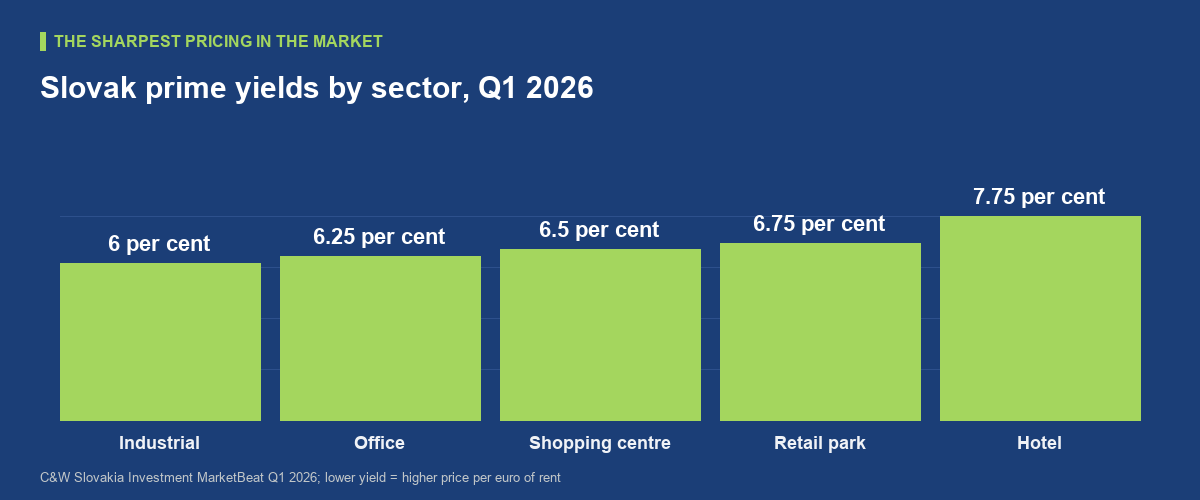
Price in a leaseback is not negotiated from sentiment; it is the rent divided by a yield. Slovak prime industrial yield held firm at 6.00 per cent in the first quarter of 2026 – the sharpest pricing in the country’s property market, ahead of offices at 6.25 per cent and retail parks at 6.75 per cent (C&W Slovakia Investment MarketBeat Q1 2026). At 6.00 per cent, every euro of sustainable annual net rent is worth roughly 16.7 euros of purchase price – our arithmetic. Scale it: a 20,000 square metre plant at the prime rent of EUR 5.30 per square metre per month (C&W Industrial MarketBeat Q1 2026) produces EUR 1.27 million of annual rent and, capitalised at the prime yield, a price around EUR 21 million – again our illustration, and secondary assets price wider. The same report explains what earns the sharpest yield: top-grade assets with long unexpired lease terms. In a leaseback the seller manufactures exactly that – the buyer’s WALT is whatever term the seller signs. The spread does the selling: 6.00 per cent against a 10-year Slovak government bond at 3.4 per cent leaves 260 basis points of premium – our subtraction – for an income stream the investor can underwrite for decades.
The CEE context: long-income capital is hunting this product
Slovak sellers are negotiating into a tailwind, because the buyers closing these deals are pan-European and hungry. The landmark is Polish: window manufacturer Eko-Okna sold and leased back two production facilities to US-listed Realty Income for over PLN 1 billion – about EUR 253 million – described as the biggest transaction of its kind ever in CEE (EurobuildCEE). In the Czech Republic, Clarion Partners Europe bought a 47,000 square metre production and logistics complex in Zatec from automotive interiors maker Yanfeng for around EUR 50 million on a 15-year triple net lease (Clarion Partners) – an automotive supplier monetising its plant, the exact profile of dozens of Slovak factories. The niche keeps compounding: logistics operator DSV agreed a further leaseback of a cross-dock terminal near Prague with Prologis in April 2026. And capital is available at home too: Slovakia’s first quarter of 2026 saw EUR 89 million transact across five deals, all of it capital of Slovak origin, with industrial described as the most liquid asset class of recent years (C&W Investment MarketBeat). A quiet quarter by volume – but for a seller, five domestic buyers plus the pan-European long-income funds is a real auction.
The lease you sign back decides everything
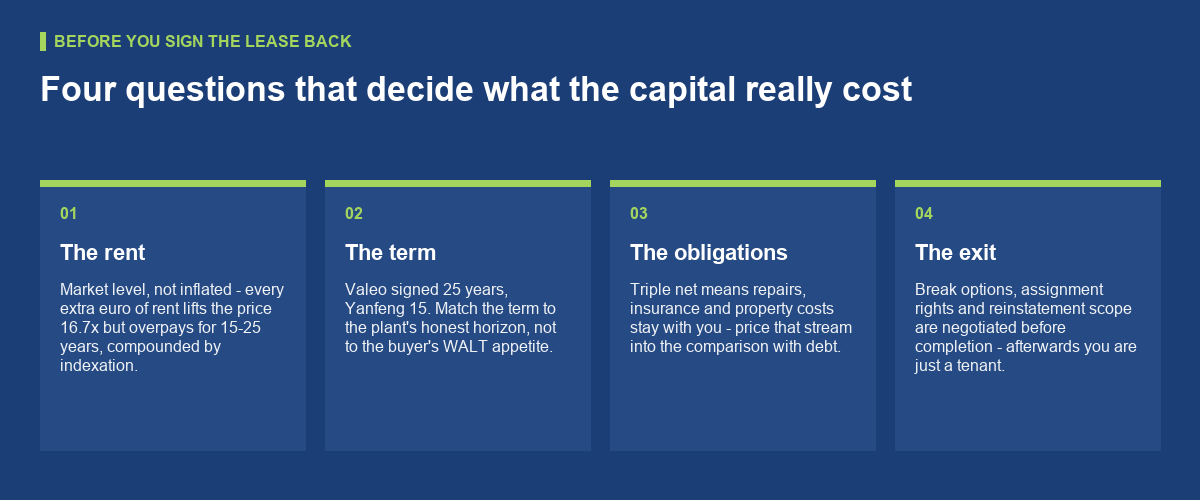
The purchase price gets the headlines; the lease determines whether the deal was good. Every term the seller concedes raises the price and the cost simultaneously – the rent because the buyer capitalises it, the cost because the seller pays it for 15 or 25 years. The discipline list is short. Set the rent at market, not above it: an inflated rent lifts the price by 16.7 times the inflation – our arithmetic from the 6.00 per cent yield – but locks the operating company into overpaying for a generation, compounded by indexation of the kind the Valeo Foods leases carry. Match the term to the plant’s real horizon: 25 years of triple net obligations on a facility the business might outgrow in ten is capital raised against the company’s own flexibility. Negotiate the exit architecture – break options, assignment rights, reinstatement scope – while you still own the building, because afterwards you are one tenant among many in a renegotiation market where 54 per cent of gross take-up is already lease renegotiation (C&W Industrial MarketBeat). Run the counterfactual honestly: rent at 6.00 per cent plus indexation against debt service at bank margins over the ECB’s 2.40 per cent refinancing rate – for some balance sheets the loan still wins.
Conclusion
The evidence says the window is open: the largest Slovak leaseback since 2018 has closed, manufacturers from food to automotive components have monetised plants across CEE at 15 to 25 year terms, and prime industrial money prices at 6.00 per cent while government bonds pay 3.4. For a manufacturer, the decision is not whether the structure works – the closed deals settle that – but whether the lease you would have to sign back is one your operation can live in for its full term. Price the lease first, the building second.