
A Slovak hall can meet every line of an institutional specification and still turn away the vehicle its tenant runs. The figure that decides it is not inside the building. Yard depth, the clear distance from the dock face to whatever stands opposite, fixes whether a 16.50 m articulated combination reverses onto a dock in one movement or in three, and it is the one dimension no fit-out budget can add after signature. This piece takes the vehicle envelope from Slovak law, borrows the stall and aisle geometry from a study the state commissioned, works the depth out in the open, and then asks why the quarterly market reports never print it.
The one line of the spec that cannot be renegotiated
Nearly every item in a building specification is negotiable after completion. Doors can be cut into a dock face, levellers upgraded, a mezzanine inserted, racking re-planned. The apron is different. Its far edge is a site boundary, a neighbouring unit or a row of parked trailers, and none of them moves for a lease clause. Our glossary entry on the truck court carries the market conventions for the apron and the lease questions that follow from them. This piece stays with the measurement itself, and with what Slovak law says about the vehicle that has to fit into it.
The market does not report it. Our own word count on the delivered text of the Cushman and Wakefield Slovakia Industrial MarketBeat for the second quarter of 2026, 1,496 words, found yard, truck court, apron, dock and circulation zero times each. The same page prices 4.89 million sq m of modern stock, records gross take-up of 93,400 sq m across 18 transactions and puts vacancy at 7.8 per cent, the highest in five years.
A report that measures the market in square metres of floor cannot see a constraint that lives in square metres of asphalt. So the number has to be produced by the reader, from the vehicle up. The rest of this article does that, and marks every step that is our own arithmetic rather than a figure in a source.
The vehicle Slovak law sends to your dock
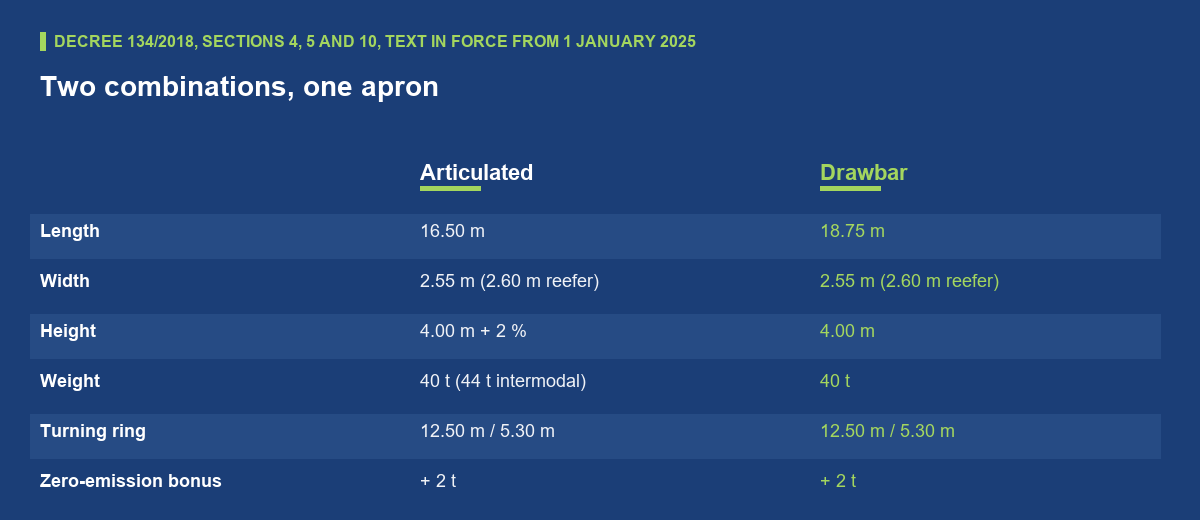
The envelope is not a matter of taste. Decree 134/2018 of the transport ministry, in the text in force since 1 January 2025, fixes the largest vehicle that may use a Slovak road without a special permit. A tractor with a semi-trailer may run to 16.50 m and a lorry with a drawbar trailer to 18.75 m. Width is 2.55 m, or 2.60 m for a refrigerated body. Height is 4.00 m, and for an articulated combination 4.00 m plus 2 per cent of that height. Two smaller figures matter more for the apron: the kingpin may sit at most 12.00 m ahead of the semi-trailer’s rear and less than 2.04 m behind its front.
The same decree, in section 10, requires any moving combination to turn inside a ring with an outer radius of 12.50 m and an inner radius of 5.30 m. Those figures and the 16.50 m are Annex I of Directive 96/53/EC, transposed. Weight follows the same path: 40 t for a combination, 44 t in intermodal transport, and up to 2 t more for a zero-emission tractor. It is the same vehicle that pays the toll by the road it uses on the way in.
A trap sits in older specifications. The regulation those documents usually cite, Government Regulation 349/2009, was repealed with effect from 20 May 2018 by the Act on the Operation of Vehicles in Road Traffic, and the numbers moved into the decree above. The values happen to be identical; the citation is not. A technical due diligence report that still quotes the repealed regulation tells you the age of the drawings it was written from.
Our arithmetic: from 16.5 metres of lorry to yard depth
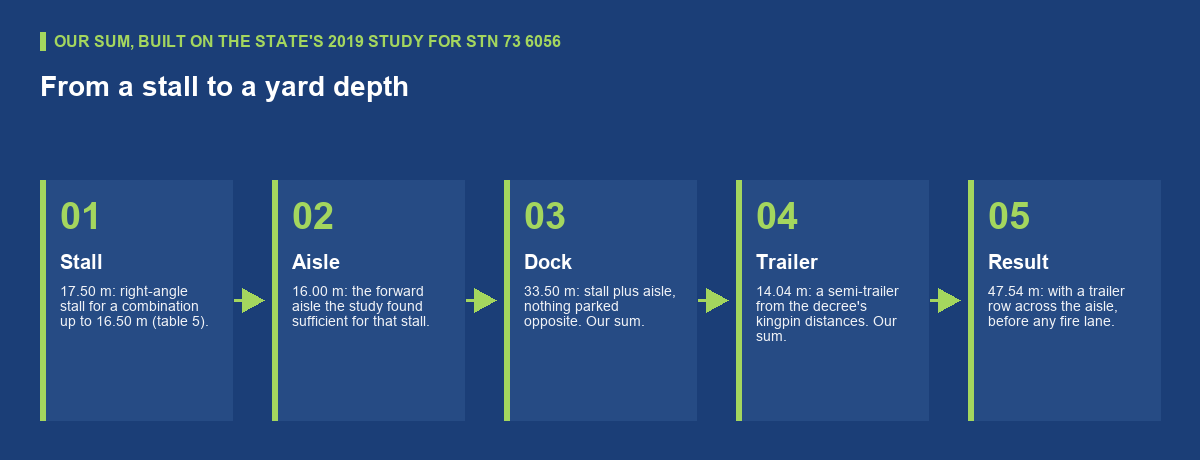
Slovak parking geometry has a standard, STN 73 6056, and its issue date is 1 August 1987. In 2019 the Slovak Road Administration commissioned the University of Zilina to prepare its revision, and the resulting study says in its opening section that the 1987 text does not reflect the vehicle fleet now on Slovak roads. It then simulates the swept paths of design vehicles and tabulates what each needs. Our glossary entry explains how those curves are produced. For a semi-trailer combination up to 16.50 m long, parked at right angles, the study gives a stall of 3.60 m by 17.50 m and an aisle of 16.00 m for driving in forwards, or 12.00 m where the vehicle only ever reverses in.
A dock is a right-angle stall against a wall, and a lorry reverses onto a leveller. Our own sum, labelled as such: 17.50 m of stall plus 12.00 m of reversing aisle is 29.50 m from the dock face to the far kerb. The study attaches a warning to that 12.00 m. Aisles sized for reversing only are for exceptional cases with no room to spare, where no simultaneous arrival is expected. A dock face at shift change is the opposite of that case, so the honest figure uses the forward aisle: 17.50 m plus 16.00 m is 33.50 m, with nothing parked opposite.
Then something is parked opposite, because trailers are dropped where the loads wait. The decree’s kingpin distances put the longest lawful semi-trailer at 14.04 m by our addition, 12.00 m plus 2.04 m. A trailer row across the aisle takes 33.50 m to 47.54 m, again our own arithmetic, and that is before a fire lane, a car route or a gatehouse. The mid-forties in institutional briefs are not generosity. They are this sum, written down by someone who has stood at a dock.
What the fire brigade takes off the apron
Fire law claims part of the depth before the first lorry arrives. Decree 94/2004 of the interior ministry, on fire safety in the construction and use of buildings, requires an access road for fire appliances to reach within 30 m of the building and of the entrance through which an intervention is expected. That road must keep a permanently free width of at least 3 m and carry an axle load of 80 kN, and a parking lane does not count towards the free width. Entries and passages on it must be at least 3.5 m wide and 4.5 m high. A dead-end single-lane access road longer than 50 m needs a turning loop or a turning area at its end.
Where the building needs a mustering area for appliances, that area must be at least 4 m wide, no steeper than 2 per cent, permanently free, signed for no standing, and connected to the access road. On a shared yard those metres are not available for queuing lorries at any hour. A trailer dropped across the fire lane is not a parking problem; it is a departure from the fire safety design the building was approved on.
The consequence for the sum above is plain. Where the free 3 m runs across the apron rather than around it, the trailer row cannot stand on it, so the row moves back and the depth grows by the width of the lane. Where the dead-end lane ends at the last docks, its turning area competes with the last two doors. A drawn depth of 40 m can hold the 33.50 m our sum needs, a 3 m lane and almost nothing else, which is our reading of the geometry rather than anything the decree says.
The lorry of 2030 is longer, and the yard is not
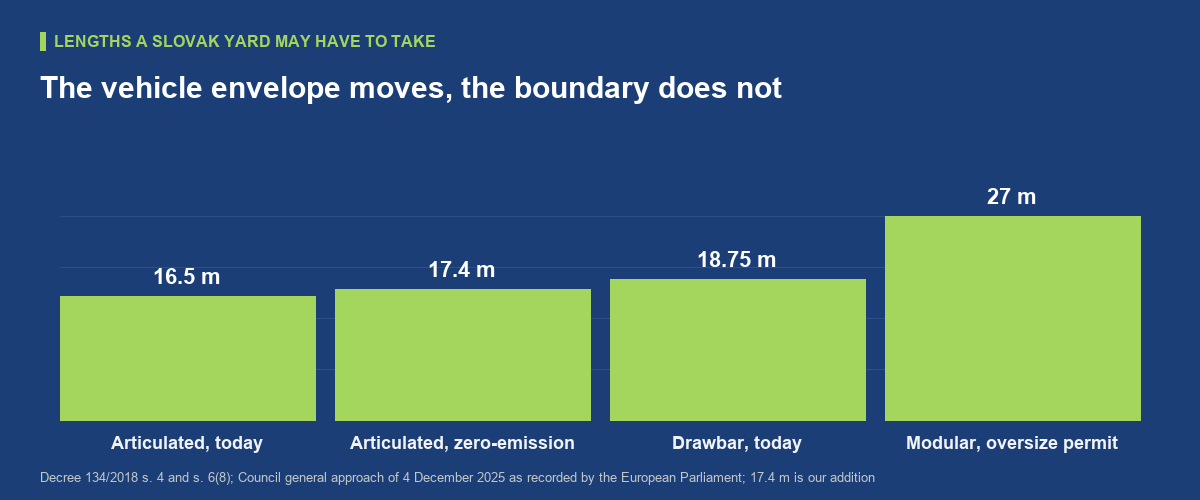
The envelope is moving. Directive 96/53/EC already carries the 2 t bonus for zero-emission tractors, and since 1 September 2020 it allows longer aerodynamic cabs. The revision proposed by the Commission on 11 July 2023 goes further. According to Parliament’s legislative record, its first-reading position of 12 March 2024 asked for four tonnes more for zero-emission lorries, and the Council’s general approach of 4 December 2025 grants a weight bonus that differs between five-axle and six-axle vehicles and lets zero-emission vehicles be up to 0.9 m longer to house the equipment. Trilogues opened on 9 December 2025 and, at the record’s last update on 1 August 2026, had not produced an agreement.
Slovakia already lets longer combinations move. The 2025 text of the decree defines the European modular system, and lets such a combination of up to 27.00 m and 60.00 t run under an oversize permit without escort vehicles, provided it carries amber warning lamps and the prescribed marking. The permit is still a permit, but the road is open.
Put the two together and the arithmetic of the previous section shifts by a vehicle class. A yard measured for 16.50 m meets a 17.40 m zero-emission combination if the Council text holds, our addition of 0.90 m, an 18.75 m drawbar combination whenever a carrier changes fleet, and a modular combination the day a permit is granted. The study’s table for the class up to 22.00 m is blunt: a right-angle stall of 23.00 m and an aisle of 24.00 m, which is 47.00 m by our sum before a trailer is parked opposite. A yard that is exact today is short tomorrow, and there is no clause that deepens it.
Conclusion
Four numbers travel with a Slovak site and none of them is in the brochure. 16.50 m is the vehicle the law sends. 33.50 m is what our sum, built on the state’s own parking study, says that vehicle needs to reverse onto a dock with a working aisle behind it. 47.54 m is the same sum with a trailer row opposite. 3 m is what the fire decree keeps free through all of it. Measure the clear depth on site rather than on the plan, subtract what fire law and trailer storage take, and set the remainder against the vehicles your carriers actually run. If the remainder is smaller than the vehicle, the rent was never the problem.