
Three neighbouring markets quote three very different prices for a modern warehouse. In the first quarter of 2026, prime industrial space cost EUR 7.50 per square metre per month in Prague, EUR 5.30 in Slovakia and as little as EUR 4.50 at the bottom of Poland’s big-box range. For CEE occupiers comparing sites across borders, that spread looks like an answer – and it is mostly a trap. This article puts the three markets side by side on one broker panel and one Eurostat dataset: headline rents, what is actually available, what labour now costs, and which costs move after signing. The cheapest number wins fewer of those rounds than you would expect.
The rent ladder: three price tags, one region
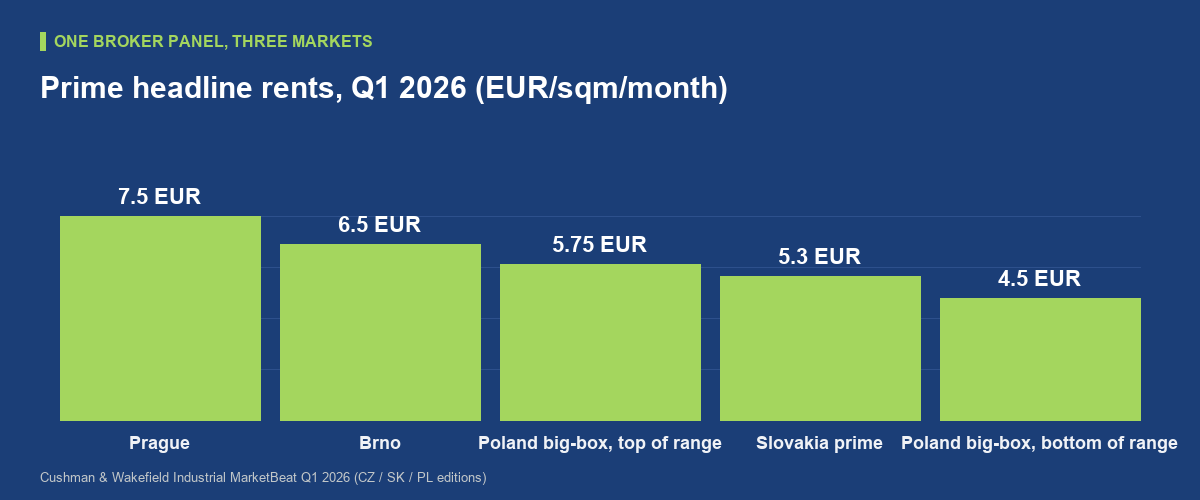
On paper the ladder is simple. Cushman & Wakefield’s Czech MarketBeat quotes prime headline rents for a 10,000 square metre unit at EUR 7.50 in Prague and EUR 6.50 in Brno, easing to EUR 5.75 in Pilsen and EUR 5.45 in Ostrava. The Slovak panel puts national prime rent at EUR 5.30 a month after a soft quarter – with Bratislava City stretching to EUR 6.50 and the regions sitting lower. Poland’s big-box range runs EUR 4.50 to EUR 5.75. Do the subtraction – our own arithmetic on the report figures – and the Prague premium over Slovak prime space is EUR 2.20 per square metre per month, roughly 42 per cent more for the same modern shell. On a 20,000 square metre unit that gap compounds into serious money every year. But a headline rent is the price of the space, not the cost of the operation – and the next three sections are where the ladder starts to reorder itself.
Availability: where CEE occupiers can actually choose
Scale is the first correction. Poland’s stock stands at 37.44 million square metres with 2.72 million vacant; gross leasing reached 1.58 million square metres in the first quarter alone, up 47 per cent on the year. Czechia holds 13.6 million square metres with 4.7 per cent vacant – a tight 639,100 square metres. Slovakia is the small market of the three: 4.86 million square metres of stock and 375,700 square metres available, at a vacancy rate of 7.72 per cent. Put one number against another – our own comparison – and Poland leases more space in a quarter than Slovakia has vacant in total. For CEE occupiers that cuts both ways. In Poland you shortlist between competing parks and landlords fight for the requirement; the Polish report itself notes that pressure to offer incentives keeps pushing effective rents below stable headlines. In Czechia the shortage sits on the other side of the table: at 4.7 per cent vacancy the landlord can wait. Slovakia currently offers a rare middle setting – elevated vacancy, softening prime rent, and a pipeline of 203,200 square metres that is only 35 per cent pre-leased, which means real choice without Polish-scale competition for the best units.
Labour: the arbitrage has moved inside the borders
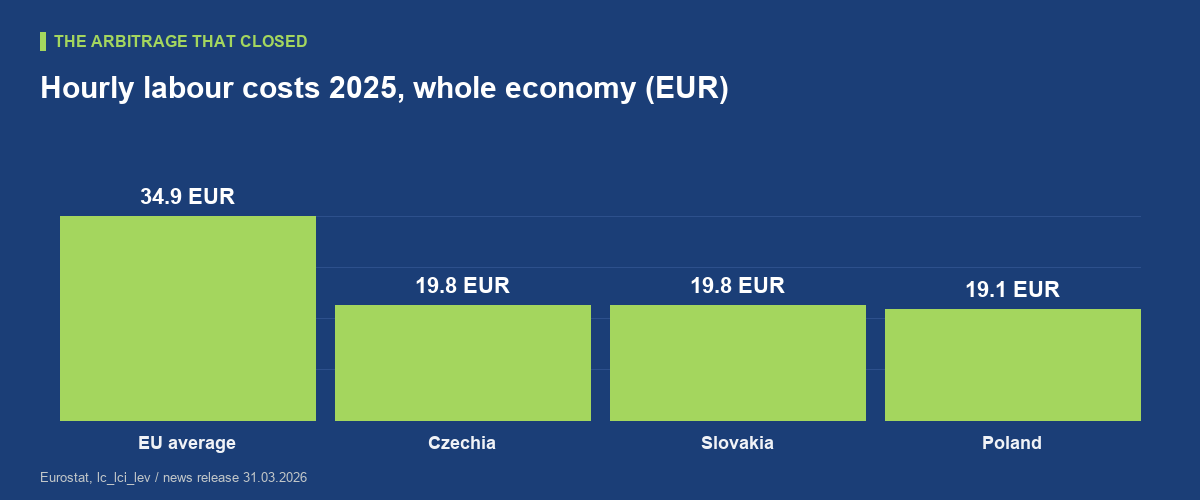
The old shortcut said: go east for cheap labour. Eurostat’s 2025 labour cost levels have quietly retired it. At whole-economy level, an hour of labour costs EUR 19.80 in both Czechia and Slovakia and EUR 19.10 in Poland – against an EU average of EUR 34.90. The three markets have converged to within seventy cents of each other; the real gap is with the West, not between the neighbours. In industry specifically, Poland is cheapest at EUR 18.20, Slovakia sits at EUR 19.70 and Czechia at EUR 20.60. Two footnotes matter more than the averages. Poland recorded one of the sharpest labour cost increases in the EU at 8.8 per cent year on year in national currency – today’s saving is on a steep escalator. And Slovakia carries the EU’s highest non-wage share of labour costs at 28.6 per cent, so the payslip understates the employer’s bill. The durable arbitrage is now regional, not national: as our labour availability piece set out, eastern Slovak unemployment runs at several times the Bratislava rate, and the Kosice Area pairs that workforce with 2.2 per cent vacancy and rents of EUR 4.80 to 5.30 – Polish-level pricing inside the eurozone.
The bill behind the rent: currency, indexation and incentives
The rent line is signed once; three other lines move every year. Currency is the quiet one. Slovakia is the only market of the three inside the euro: leases, wages, energy and service charges all clear in the same currency as the rent. In Poland and Czechia the lease is typically euro-denominated while payroll runs in zloty or koruna – a structural mismatch that sits on the occupier’s P&L and has just shown its teeth in Poland’s 8.8 per cent wage-cost jump. Indexation is the second line: a euro-area lease indexes off euro-area inflation, while the headline you negotiated in Warsaw or Prague compounds off whatever the local basis clause says – worth reading before celebrating a low starting rent. Incentives are the third. The Polish market’s own report describes landlords under growing pressure to give them; Slovakia’s soft quarter creates the same dynamic, with renegotiations at 54 per cent of gross demand as sitting tenants re-cut terms; Czechia, at sub-five vacancy, concedes the least. The effective rent – after rent-free months, fit-out money and the indexation base – is the number the three markets should be compared on, and it is never the one on the brochure.
The per-euro answer: match the market to the mission
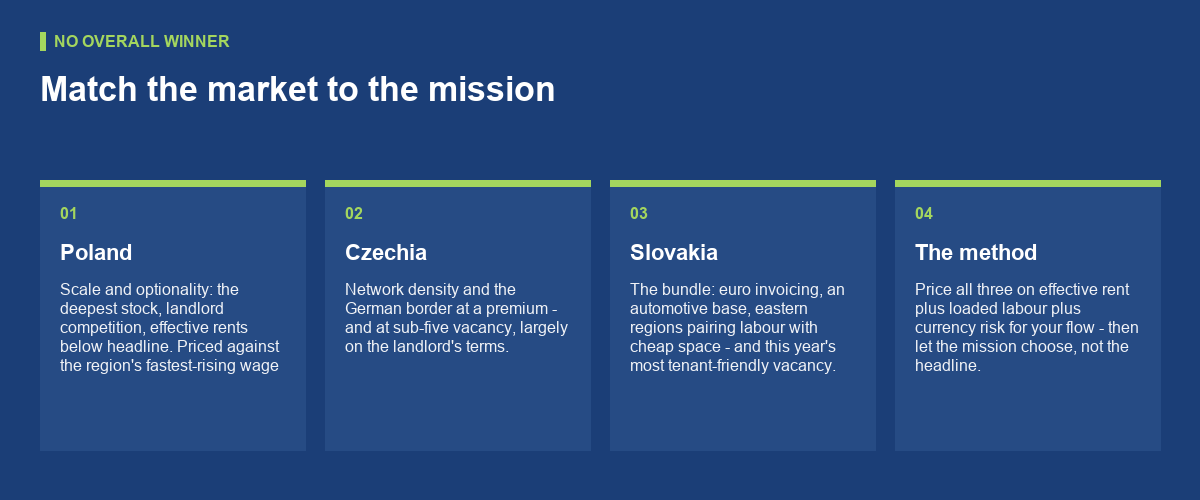
There is no overall winner – there is a right market per requirement. If the mission is scale, optionality and the lowest entry rent, Poland is hard to beat: the deepest stock, the most landlord competition, and effective rents drifting below headline. The price is the fastest-rising wage bill in the region and a currency mismatch to manage. If the mission is serving Germany and Czech-plus-Bavarian networks at maximum density, Czechia justifies its premium – but at 4.7 per cent vacancy you pay it on the landlord’s terms. Slovakia earns its place when the bundle matters: euro invoicing with no currency risk, an automotive-industrial base that took roughly 71 per cent of gross leasing in the first quarter, eastern regions where labour and 2.2 per cent-vacancy space coexist, and a tenant-favourable window – 7.72 per cent vacancy and softening prime rents – that the other two markets are not offering this year. The honest method: price all three on effective rent plus loaded labour plus currency risk for your specific flow, then let the mission, not the headline, choose the market.
Conclusion
The rent ladder says Poland is cheap, Czechia is dear and Slovakia sits in between. The operating reality is less tidy: labour costs have converged to within cents, the cheapest market carries the steepest wage escalator, the dearest is the tightest, and the one in the middle is the only one that invoices in euros – currently with the most tenant-friendly vacancy of the three. Per euro of rent, the best buy depends on what the operation needs the euro to do. Compare effective rents, not headlines; loaded labour, not payslips; and the market’s direction, not its snapshot.